Understanding Peptide Pureness Screening
Air Conditioner Peptide Testing Labs Third-party Peptide Evaluation
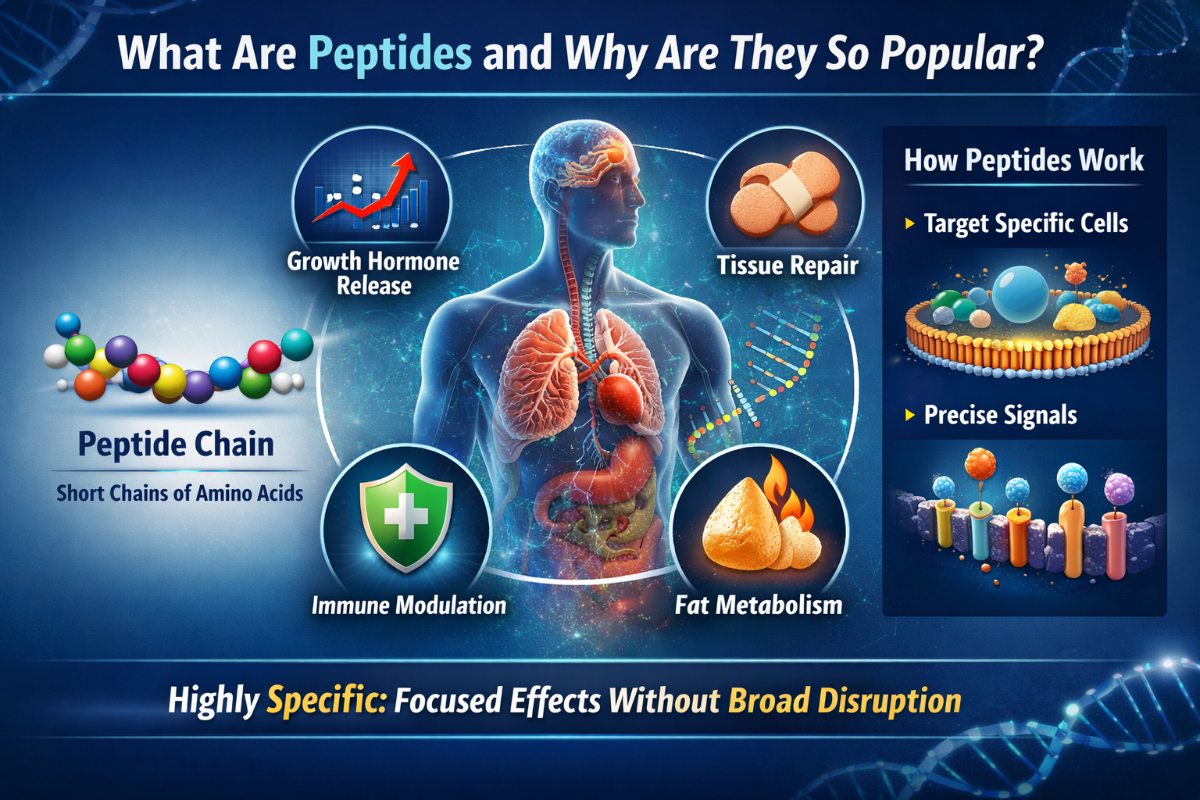
Comprehending Peptide Pureness Screening
- We pick methods according to peptide size, hydrophobicity, fee profile, and alteration status as opposed to compeling every example into one theme.
- These modifications transform the peptide's organic activity and chromatographic profile.
- If topping isn't perfectly effective, an uncoupled chain can remain to elongate in succeeding steps, producing a peptide that's only one deposit short of the target.
- If the COA notes "total impurities", that complements the purity number (e.g., 98% purity suggests 2% complete pollutants).
Nevertheless, accomplishing ultra-high purity (state 99%) can be practically tough and might not always be necessary, as we'll talk about later. The trick is comprehending what degree of pureness is sufficient for your needs and exactly how purity is figured out in the first place. For the majority of research study functions, high purity suggests you can be confident that the huge majority of the particles in your vial are the appropriate peptide, which assists ensure speculative consistency and reproducibility. Our workflow is created to move from sample context review to interpretable peptide information with minimal logical obscurity. Jobs can range from one sample identification check to multi-lot comparability, residual testimonial, solubility evaluation, or stability-focused analytical plans. Hydrophobic peptides, very basic sequences, changed constructs, and carefully relevant analogs can be reviewed with technique modifications matched to their analytical dangers.
The quality and reliability of a peptide purity dimension rely on technique specifications and documentation high quality. The mobile stage, often a mix of water, acetonitrile, and an acid modifier, is saved in reservoirs and delivered via the system by a high-pressure pump. The pump maintains precise circulation prices, generally in the series of 0.5 to 2.0 mL/min depending on the approach and column layout. High pressure requires the mobile phase with firmly loaded bits inside the column, generating sharper splittings up and higher resolution than standard low-pressure chromatography.Sorts Of Impurities Hplc Spots
Maintaining a high degree of pureness is vital because impurities can impact bioassays or responses. For instance, truncated peptides or chemically changed side-products may bind to targets or create side effects that puzzle your results. Particularly customized peptides or cyclic peptide series are hard to verify, which affects quality control. We incorporate LC-MS/MS and enzymatic food digestion analysis to precisely confirm the sequence and alteration sites of non-natural changed peptides. Residual organic solvents, metal ions, or by-products from synthesis may trigger poisonous side effects.Straight from the synthesizer with very little handling-- commonly just cleavage from the material and rainfall. Purity varies commonly, from 40% to 80%+ depending on sequence length and problem. Unrefined peptides are suitable for applications where pureness isn't critical, such as antibody production or initial screening assays where the target peptide just needs to be present, not leading. Closely related to truncations, removal peptides are unabridged chains that are missing one amino acid someplace between. If covering isn't completely effective, an uncoupled chain can remain to lengthen in succeeding steps, producing a peptide that's just one deposit except the target.
Together, these analytical techniques give the proof base for ending that a peptide batch appropriates for study usage. An additional relevant term you could run into is web peptide web content, which is different from pureness. Web peptide material describes just how much real peptide (by weight) is in the vial relative to non-peptide parts like water, counter-ions (e.g., TFA), or buffer salts.